



Multiple Myeloma
Latest News
Advertisement
Latest Videos
CME Content































Advertisement
More News

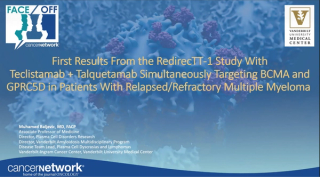
Findings from the phase 1b RedirecTT-1 study may support initiating larger studies evaluating teclistamab plus talquetamab for patients with relapsed or refractory multiple myeloma.
Results from the phase 2 DARIA trial found an improved overall response rate in patients given daratumumab, ixazomib, and dexamethasone with relapsed/refractory multiple myeloma who were previously treated with lenalidomide.
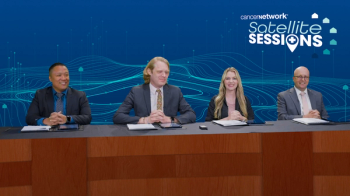
Focused discussion on the historical use of triplet regimens as induction therapy in transplant-eligible newly diagnosed multiple myeloma.
Insights gleaned from the MAIA trial, which researched daratumumab, lenalidomide, and dexamethasone in patients with newly diagnosed MM.
Opening its discussion on the management of multiple myeloma, a panel of experts from Ochsner Health reviews risk stratification strategies via NCCN and mSMART guidelines.
Myeloma experts present the case of a 74-year-old with transplant-ineligible newly diagnosed MM and offer their initial impressions.

A Satellite Sessions program at the Yale Cancer Center discusses treatment paradigms and unmet needs in multiple myeloma as well as transplantation, bispecific T-cell engaging therapies, and the importance of collaborative decision-making in clinical practice.
April Logue, APRN-CNP, shares her perspective on selecting between doublet and triplet regimens for patients with transplant-ineligible newly-diagnosed multiple myeloma.
Naresh Bumma, MD, reviews updated data from the MAIA trial in transplant-ineligible newly-diagnosed multiple myeloma.
Findings from the phase 3 CARTITUDE-4 study support the supplemental biologics license application for ciltacabtagene autoleucel in the treatment of relapsed/refractory multiple myeloma.
The panel discusses how to educate patients and caregivers on infections risks when receiving an anti-BCMA bispecific antibody.
The panel shares their experiences with the sequencing of BCMA-targeting therapies in MM, with particular focus on treatment of patients who progress on CAR T-cell therapy with teclistamab.
Jeremy Larsen, MD, discusses data from a phase 1/2 study of cevostamab and other emerging bispecifics being evaluated in patients with relapsed/refractory multiple myeloma.
Expert Shaji Kumar, MD, spearheads a review of data from MajesTEC-1 and use of teclistamab therapy in patients with relapsed/refractory multiple myeloma.
An expert panel offers their initial impressions on the case of a 77-year-old with multiple myeloma treated with a BCMA bispecific antibody who develops neutropenia.
Opening the panel’s discussion on multiple myeloma management, Rafael Fonseca, MD, reviews treatment options available to patients at early or late relapse.
A panel of experts on multiple myeloma discuss the use of IVIG in the management of hypogammaglobulinemia in patients treated with bispecific antibodies.
Dr Jack Khouri highlights recent data updates on other BCMA-targeting bispecific antibodies that are in clinical development in multiple myeloma.
Dr Jeremy Larsen reviews data from the MonumenTAL-1 study investigating the CD3- and GPRC5D-targeting bispecific antibody talquetamab in relapsed/refractory multiple myeloma.
Robert Mancini, PharmD, explains the viral infections commonly seen in multiple myeloma patients treated with anti-BCMA bispecific antibodies.
Ciltacabtagene autoleucel may become a new standard of care for patients with lenalidomide-refractory myeloma after first relapse, according to an expert from the Medical College of Wisconsin in Milwaukee.
Key opinion leaders share comprehensive insight on optimal dosing and sequencing strategies in patients with relapsed/refractory multiple myeloma.
A brief conversation on the introduction and use of bispecifics and CAR T-cell therapies in satellite campuses for patients with relapsed/refractory multiple myeloma.
GCF012F may show promising activity in relapsed and refractory multiple myeloma, according to an expert from Shanghai Chang Zheng Hospital.
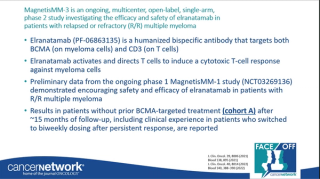
For the pooled analysis, investigators evaluated the efficacy and safety of bispecific antibody elranatamab in patients with relapsed/refractory multiple myeloma enrolled in 1 of the 4 MagnetisMM trials who received at least 1 proteasome inhibitor, 1 immunomodulatory drug, 1 anti-CD38 monoclonal antibody, and 1 BCMA-directed ADC and/or CAR T-cell therapy.
Advertisement
Advertisement
Trending on CancerNetwork
1
Modifiable Risk Factors Suggest Potential for Improving Cancer Prevention
2
Barriers to CAR T-Cell Referral and Center Access in Multiple Myeloma
3
2026 Tandem Meetings: What’s the Latest Research in Multiple Myeloma?
4
Real World Outcomes of CAR T-Cell Therapy in Multiple Myeloma Including Older and Comorbid Patients
5