

Opinion|Videos|February 28, 2025
Frontline Treatment and Molecular Testing in Upper GI Cancer: Precision-Guided Therapy
Experts discuss frontline treatment options for advanced upper gastric adenocarcinoma, molecular testing methods, challenges encountered, and how test results influence the choice of systemic therapy for patients.
Advertisement
Episodes in this series
Video content above is prompted by the following:
- Before we dive in, could you briefly provide an overview of frontline treatment options for patients with advanced upper gastric adenocarcinoma?
- When do you perform molecular testing, and what choice of testing method do you use?
- What are some challenges that you have encountered?
- How do the results influence the choice of systemic therapy in this patient?
Advertisement
Related to this article
The panel discussed the risk-benefit profile of the Galleri multicancer early detection test, which was evaluated in the NHS-Galleri and PATHFINDER 2 studies.

“Cardiovascular assessment should begin when the patient is being selected for treatment, not after the toxicity emerges,” said Faisal Mehmud, MD, MRCP.
The FDA has approved lirafugratinib for advanced cholangiocarcinoma harboring an FGFR2 fusion or other rearrangement based on the phase 1/2 ReFocus trial.

Meletios A. Dimopoulos, MD, discussed where bispecific antibodies such as teclistamab may fit for patients with relapsed Waldenström macroglobulinemia.

In the LINKER-SMM1 trial, single-agent linvoseltamab produced a 100% overall response rate among evaluable patients with high-risk smoldering multiple myeloma.

Hematologic specialists discussed where ciltacabtagene autoleucel fits in the treatment paradigm at first relapse and beyond in multiple myeloma.
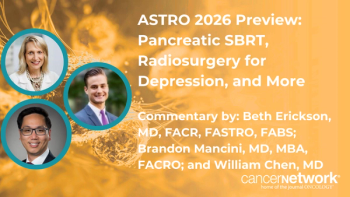
Experts preview ASTRO 2026 presentations to watch, including those on SOFT Preop, PSMAgRT, radiosurgery for depression, and AI tools for patient safety.

Data from the phase 3 MK-3475A-D77 trial support the Japanese approval of subcutaneous pembrolizumab and berahyaluronidase alfa.