Bhanu Prasad Venkatesulu, MBBS, MD, discussed why fewer radiation oncologists offer prostate brachytherapy and the patients for whom he still recommends it.
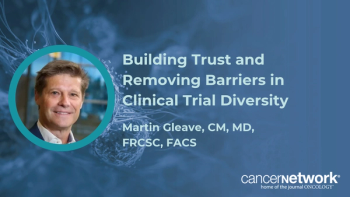
Martin Gleave, CM, MD, FRCSC, FACS, discussed perioperative therapy selection, the GUNS trial, and postoperative radiotherapy in prostate cancer.
Perioperative systemic therapy around radical prostatectomy gained new momentum in 2026, when the
At the 44th Annual Chemotherapy Foundation Symposium (CFS), CancerNetwork® spoke with Martin Gleave, CM, MD, FRCSC, FACS, distinguished professor in the department of Urologic Sciences at the University of British Columbia in Vancouver, Canada, about how these data and emerging genomic insights may shape the perioperative management of prostate cancer.
Gleave began by explaining which patients with high-risk localized disease are most likely to benefit from perioperative treatment intensification. He then discussed what the biomarker-directed Genomic Umbrella Neoadjuvant Study (GUNS; NCT04812366) has shown about matching neoadjuvant therapy to tumor genomics. Finally, he outlined how he approaches the choice between adjuvant and early salvage radiotherapy after prostatectomy.
Gleave: You have to recognize that localized prostate cancer is a wide spectrum of aggressiveness, histologically as well as genomically, from low to intermediate to high risk. Even within the high-risk cohort, there is a low tier, a high tier, and a very high-risk tier of nonmetastatic, high-risk localized prostate cancer. What studies such as [the phase 3 ENZARAD/ANZUP 1303 trial (NCT02446444)] are showing is that unless you enrich for higher-volume, high-grade cancers, the event rates from treating the lower-tier high-risk subgroup are too low. In other words, cure rates are reasonably high with current standards of care, such as ADT plus radiation in ENZARAD. Similarly, surgery monotherapy has a high cure rate in that group. The events you are trying to affect down the road are fewer, so it is harder to find a difference with additional therapy.
If a patient has a low-volume Gleason [grade group] 4 cancer with a prostate-specific antigen [PSA] level of 8 [ng/mL], even though he is high risk, he is low-tier high risk and does not benefit from the PROTEUS regimen. Indeed, PROTEUS and the GUNS trial that I run enrich for high-volume, high-grade disease. They require multiple positive cores with Gleason pattern 4 or 5 and/or a PSA level above 20 [ng/mL], which is another marker of disease burden.
From a clinical judgment and patient selection perspective, the sweet spot is higher-volume, high-grade disease. However, if you are considering surgery, these patients still have to fall within the clinical judgment of resectability and appropriateness for surgery. You are not going to make somebody who is unresectable resectable with systemic therapy, and that is where surgical judgment comes in.
Right now, what PROTEUS, ENZARAD, and the [phase 3 DASL-HiCaP/ANZUP 1801 (NCT04136353)] high-risk trials are teaching us is that we are using clinicopathologic risk stratification to decide who would benefit from treatment intensification with an androgen receptor pathway inhibitor [ARPI] doublet vs ADT alone. We know that in advanced prostate cancer, we can improve outcomes by building on an ARPI doublet: adding a PARP inhibitor for BRCA-altered disease, adding an AKT inhibitor for PTEN-altered disease, and potentially adding chemotherapy for aggressive phenotypes. The question is whether we can improve outcomes if we further stratify high-risk localized prostate cancer into genomic baskets where we understand the biology, or at least have a therapeutic tool that exploits that underlying biology.
PROTEUS accepts and treats all high-risk phenotypes the same, but we know that not all high-risk prostate cancers share the same genomics, so they do not share the same vulnerabilities to AR pathway inhibition alone. Some subgroups are more sensitive to AR pathway inhibitors, and that is one area GUNS is testing. If you enroll only patients with genomic alterations that drive AR biology, such as SPOP and FOXA1 alterations, and exclude the alterations that drive an aggressive biology, such as TP53 and PTEN, you may identify a group of patients who are more sensitive to AR pathway inhibition. That is what the subprotocol 1 analysis from GUNS is demonstrating: by intensifying from an ARPI doublet to a triplet with abiraterone [Zytiga], we are seeing a greater depth of pathologic response.
The next question is whether that depth of pathologic response translates into something clinically meaningful, such as [an improvement] in metastasis-free survival. That will require a hypothesis-testing trial. GUNS is a hypothesis-generating trial designed to provide sufficient information to justify a much larger study of clinically meaningful end points.
The other segment of GUNS reported thus far is subprotocol 2, the aggressive genotype. We know that TP53 alteration, PTEN loss, AKT gain, and RB1 loss are associated with an aggressive phenotype, one that responds poorly, or at least only briefly, to an ARPI doublet. We asked whether we could deepen the pathologic response by intensifying that doublet to a triplet with docetaxel chemotherapy. Subprotocol 2 is showing that patients with an aggressive genotype do not have any deep pathologic responses to an ARPI doublet alone. When you add docetaxel as a triplet, we see a shift in residual cancer burden toward lower volumes, as well as a major pathologic response in about 25% of patients.2
That suggests that when we treat patients with aggressive genomic alterations, we should be thinking about how to intensify therapy, at least in more advanced disease. That is ultimately what is being done with the addition of chemotherapy in the PEACE trials and the addition of an AKT inhibitor for PTEN-altered disease. In the future, we have to ask whether we can bring that into a hypothesis-testing study. That will hopefully be the next wave of neoadjuvant studies.
Many studies have shown that adjuvant radiation after surgery treats all patients, whereas early salvage treats perhaps 50% of patients, those who recur, and the outcomes are the same.3 The difference is that with adjuvant therapy, everybody receives radiation, and that is something you want to avoid if you do not need it, or at the very least defer while patients recover from surgery. Surgical repair and recovery is usually a 6-month journey, not a 6-week journey. The more we can defer postoperative radiation, the more functional recovery, with regard to continence, other bladder function, and sexual function, is allowed to emerge. The earlier you apply radiation, the more that recovery is negatively affected.
In prostate cancer, unlike most other cancers, we have an exquisite biomarker, PSA, that separates recurrence from nonrecurrence. That is why we can wait and offer early salvage rather than adjuvant therapy. Breast cancer and colorectal cancer do not have anything like that, so you have to come in with adjuvant therapy rather than early salvage.
There are exceptions in high-risk localized prostate cancer. If you underestimated disease burden and there are significant positive surgical margins or nodal disease, you can make an argument for earlier adjuvant radiation while the patient is still receiving a postoperative ADT regimen, but that is in highly selected patients. My own bias is that waiting for functional recovery and an early biochemical readout enriches for those who are destined to fail. You can also then apply a PSMA PET scan. If you perform a PSMA PET scan before PSA starts to rise, you are not going to detect recurrent disease. If you wait for PSA to recur, you can use that anatomic information to better target your salvage radiation, giving boosts to regional disease or even stereotactic body radiation therapy [SBRT] to oligometastases outside the pelvis.