
Panelists discuss how high-risk disease biology and recent bispecific therapy heighten the need for timely, individualized sequencing and rigorous safety planning around infections, cytopenias, and early monitoring.

Your AI-Trained Oncology Knowledge Connection!
Panelists discuss how high-risk disease biology and recent bispecific therapy heighten the need for timely, individualized sequencing and rigorous safety planning around infections, cytopenias, and early monitoring.
Panelists discuss how recent bispecific exposure does not necessarily preclude CAR T, but timing, disease tempo, infection/immune assessments, and realistic scheduling expectations shape readiness and planning.
Panelists discuss how clinicians set expectations for the acute toxicity window and monitoring while also considering how rising disease burden or prior BCMA exposure can influence efficacy and reinforce urgency of referral.
Panelists discuss how older patients with cardiac/renal comorbidities may still be appropriate CAR T candidates when conditions are well-managed, and why early evaluation protects eligibility and aligns care with patient goals.
Panelists discuss how complete referral information and evolving outpatient pathways (including shortened post-infusion monitoring requirements) can improve coordination, reduce logistical burden, and maintain safe follow-up.
Panelists discuss how transparent counseling on expected benefits, early-onset toxicities, and practical logistics (travel, caregiver needs, support resources) helps patients make confident decisions about CAR T.
Panelists discuss how early financial navigation and proactive payer coordination can mitigate insurance delays and out-of-pocket burdens that commonly derail CAR T access.
Panelists discuss how clearer communication and streamlined referral workflows (including dedicated navigation/support roles) can reduce uncertainty around scheduling, manufacturing timelines, and treatment capacity.
Panelists discuss how early referral drop-off is driven by awareness gaps, outdated perceptions of when CAR T should be used, travel/caregiver burdens, and process complexity—and which barriers are most addressable.
Panelists discuss how real-world CAR T outcomes in older or comorbid patients can mirror trial results when organ function, monitoring, and multidisciplinary support are optimized.
Panelists discuss how sequencing choices before third-line CAR T balance disease control and eligibility preservation, while avoiding prolonged therapies that could compromise later collection or outcomes.
Panelists discuss how prior BCMA-directed or bispecific therapy may affect T-cell fitness and CAR T planning, including the value of early referral and strategic washout/bridging approaches when feasible.
Panelists discuss how clinicians distinguish candidates for second-line versus third-line CAR T by weighing disease aggressiveness, relapse timing, cytogenetic risk, patient preferences, and toxicity tradeoffs.
Panelists discuss how differences in BCMA-directed CAR T constructs (including binding configuration and expansion kinetics) can influence toxicity timing, monitoring needs, and real-world product selection.
Panelists discuss how pivotal trials and real-world evidence have reinforced CAR T-cell therapy’s high response rates, deep remissions, and durable outcomes in relapsed/refractory multiple myeloma.
Panelists discuss how evolving MRD-driven and immune-based therapies are shaping a personalized future for NDMM management.
Panelists discuss how infection prevention and selective IVIG use are critical for maintaining safety during NDMM combination therapy.
Panelists discuss how daratumumab plus KRd demonstrates manageable toxicity and strong real-world feasibility with appropriate supportive care.
Panelists discuss how ADVANCE findings support the use of quadruplet therapy in both transplant-eligible and -ineligible patients with NDMM.
Panelists discuss how ADVANCE results show daratumumab-based quadruplets achieve high MRD negativity across risk and age groups in NDMM.
Panelists discuss how the ADVANCE trial’s inclusive design and MRD-based end points make it a model for future NDMM research.
Panelists discuss how the ADVANCE study was structured to determine whether adding daratumumab to KRd enhances depth and durability of response in NDMM.
Panelists discuss how comprehensive diagnostic and functional pretesting ensures safe and effective initiation of quadruplet therapy in NDMM.
Panelists discuss how risk stratification using cytogenetic and molecular markers is vital to tailoring NDMM therapy and improving long-term outcomes.
Panelists discuss how quadruplet therapy has become the new benchmark for NDMM, offering deeper and more durable responses than previous triplet regimens.
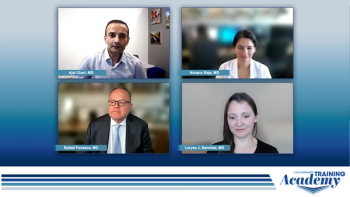
Noopur Raje, MD, discusses the role of T-cell affinity in bispecific therapy for patients with relapsed/refractory multiple myeloma and how it impacts treatment practices.
The panel discusses the benefits of having multiple BCMA-targeting bispecifics available for patients with relapsed/refractory multiple myeloma.
Rafael Fonseca, MD, discusses the role of bispecifics in relapsed/refractory multiple myeloma and the implications of incorporating them into combination regimens.
Noopur Raje, MD, reviews clinical research on elranatamab combination therapy in patients with relapsed/refractory multiple myeloma.
Focusing on clinical trials evaluating combination strategies with bispecifics, Larysa J. Sanchez, MD, discusses the TRIMM-2, TRIMM-3, and MajesTEC-3 studies.

July 19th 2022
July 11th 2022
July 11th 2022
November 3rd 2025