




Non-Small Cell Lung Cancer (NSCLC)
Latest News
Advertisement
Latest Videos


CME Content































Advertisement
More News

Dr. Gregory Gan presents Case 4, featuring a 71-year-old diagnosed with Stage IIIA NSCLC experiencing pneumonitis following Chemo-IO treatment, prompting a discussion with expert insight on the monitoring and management of this condition.

Findings from 3 phase 3 trials support the marketing authorization application for tislelizumab as a treatment for patients with non–small cell lung cancer in the European Union.

Preliminary findings from a phase 1 trial support the breakthrough therapy designation for BAY 2927088 as a treatment for those with unresectable or metastatic non–small cell lung cancer harboring HER2 mutations.

The European Medicine Agency’s Committee for Medicinal Products for Human Use’s recommendation of approving pembrolizumab plus chemotherapy in resectable non–small cell lung cancer is based on results from the KEYNOTE-671 trial.

Results from the phase 3 LAURA trial found a statistically significant PFS benefit and a positive trend in OS with osimertinib following chemoradiotherapy in patients with stage III EGFR-mutated non–small cell lung cancer.

Findings from the phase 3 TROPION-Lung01 trial support the biologics license application for datopotamab deruxtecan as a treatment for those with advanced nonsquamous non–small cell lung cancer.
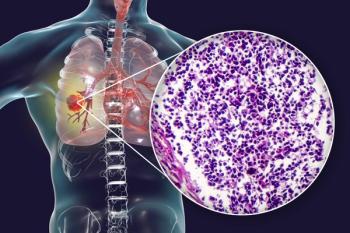
Findings from the phase 2 UNICORN trial support osimertinib as a potential treatment option for patients with metastatic non–small cell lung cancer harboring uncommon EGFR mutations.

Secondary primary lung cancer rates and cumulative incidence rates were similar in multiple subgroups of patients with stage T1aN0 non–small cell lung cancer.

Data from the phase 3 FLAURA 2 trial support the FDA approval of osimertinib plus chemotherapy for treating patients with EGFR-mutated non–small cell lung cancer.

Data from the phase 3 RATIONALE-315 study support the use of perioperative tislelizumab plus neoadjuvant chemotherapy in resectable stage II to IIIA non–small cell lung cancer.

Narjust Florez, MD, and Sandip P. Patel, MD, cohosted a X chat centering on treatment options for KRAS G12C non–small cell lung cancer.
Results from the phase 2 VISION trial have allowed for tepotinib to receive full approval by the FDA in non–small cell lung cancer harboring MET exon 14 skipping alterations.


The FDA set a Prescription Drug User Fee Act date of June 15, 2024 for repotrectinib as a treatment for those with advanced or metastatic solid tumors harboring an NTRK gene fusion.

Lisa Carter-Bawa PhD, MPH, APRN, ANP-C, FAAN, discusses how LungTalk, a health communication and decision support tool, may spread awareness and knowledge surrounding lung cancer screening.

The CROWN and ADURA trials were discussed and defended as part of a non–small cell lung cancer Face Off.
Data from the phase 3 MARIPOSA study support the Type II application for amivantamab plus lazertinib as a treatment for those with EGFR-mutated non–small cell lung cancer.

Treatment with repotrectinib in patients with ROS1 fusion–positive non–small cell lung cancer results in mostly low-grade adverse effects in the phase 1/2 TRIDENT-1 trial.

Resection can be safely performed in select patients with cT4 non–small cell lung cancer without compromising perioperative survival, according to Neel Chudgar, MD.

Both the FDA and European Medicines Agency applications were based on findings from the phase 3 CheckMate-77T trial in patients with resectable non–small cell lung cancer.
Adding bevacizumab to atezolizumab plus carboplatin and pemetrexed appears to be tolerable among patients with metastatic nonsquamous non–small cell lung cancer.

Data from the phase 3 INSPIRE trial may support iruplinalkib as a new treatment option for those with advanced ALK-positive non–small cell lung cancer.
A panel of oncology experts examine the role of consolidation immunotherapy in patients receiving concurrent chemoradiotherapy for unresectable Stage-III NSCLC, discussing 5-year survival outcomes from the PACIFIC trial, the impact on institutional treatment approaches, criteria for selecting patients for consolidation durvalumab, the significance of baseline scans, as well as exploring real-world evidence on consolidation durvalumab.
Krishna Reddy, MD, PhD, explores the roles of sequential and concurrent chemoradiotherapy (sCRT and cCRT) in patients with unresectable stage III NSCLC, delving into considerations for selecting between the two approaches and examining potential variations in treatment based on factors such as age, performance status (PS), or comorbidities.

The FDA will review the supplemental biologics license application for alectinib based on data from the phase 3 ALINA study.
Advertisement
Advertisement
Trending on CancerNetwork
1
Modifiable Risk Factors Suggest Potential for Improving Cancer Prevention
2
2026 Tandem Meetings: What’s the Latest Research in Multiple Myeloma?
3
Dato-DXd Receives Priority Review in Unresectable/Metastatic TNBC
4
Barriers to CAR T-Cell Referral and Center Access in Multiple Myeloma
5