



Non-Small Cell Lung Cancer (NSCLC)
Latest News
Advertisement
Latest Videos



CME Content































Advertisement
More News
Isabel Preeshagul, DO, MBS, and the Oncology Brothers discuss the treatment of patients with NSCLC and actionable mutations following progression on first-line therapy.
Medical oncologists discuss the role of dual checkpoint inhibitors with chemotherapy in the treatment of patients with metastatic non–small cell lung cancer.
Isabel Preeshagul, DO, MBS, joins the Oncology Brothers, Rahul Gosain, MD, and Rohit Gosain, MD, to discuss treatment practices for newly diagnosed patients with metastatic non–small cell lung cancer (NSCLC) and no actionable mutations.
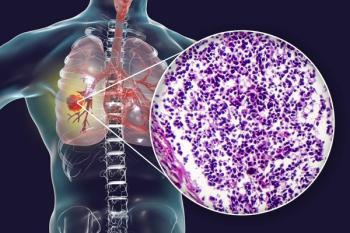
As of data cutoff, 6 patients with NSCLC in the phase 2 THIO-101 trial are receiving ongoing treatment with THIO plus cemiplimab after 12 months.

Feedback from a Type C meeting signals the end of preparatory regulatory interactions for the phase 3 TACTI-004 trial’s design in metastatic NSCLC.

Preclinical data support the potential anti-tumor activity and tolerability of a novel FR⍺ topoisomerase I inhibitor in ovarian cancer and NSCLC.
Balazs Halmos, MD, and the Oncology Brothers discuss therapeutic practices for patients with NSCLC, highlighting how MET exon 14 skipping mutations and RET rearrangements inform treatment decisions.
The Oncology Brothers and Balazs Halmos, MD, provide clinical insights on therapeutic options for patients with NSCLC with rare mutations, including ROS1, BRAF V600E, and NTRK.
Medical oncologists discuss therapeutic practices for patients with non–small cell lung cancer with ALK mutations.
A thoracic medical oncologist provides insights on the treatment of patients with non–small cell lung cancer with uncommon EGFR mutations.

The conundrum of treating dermatologic adverse effects in response to treatment with amivantamab for EGFR-mutated NSCLC was discussed in a recent Frontline Forum.
The results of the trial showed that at least 75% of patients with NSCLC harboring driver gene alterations may benefit from this treatment.

Findings from the phase 3 FLAURA2 trial support the European approval of osimertinib/chemotherapy in EGFR-mutated non–small cell lung cancer.

Developers intend to halt the phase 2/3 SKYSCRAPER-06 trial assessing tiragolumab plus atezolizumab and chemotherapy in nonsquamous NSCLC.
The first-in-class tetravalent bispecific antibody may show binding affinity to PD1 and VEGF based on in vitro studies.
The complete response letter for patritumab deruxtecan is based on findings related to a third-party manufacturing site inspection.

The approval for osimertinib/chemotherapy by the Japanese Pharmaceuticals and Medical Device Agency was based on results from the phase 3 FLAURA2 trial.
Disease-free survival did not show statistical significance for patients with early-stage non–small cell lung cancer treated with durvalumab.
Misako Nagasaka, MD, PhD, discussed the approval of amivantamab plus chemotherapy for patients with EGFR exon 20 insertion mutations non–small cell lung cancer.

A trial for BNT326/YL202 in EGFR-mutated NSCLC or HR-positive HER2-negative breast cancer has paused enrollment due to a large illness or injury risk.
Data from the phase 3 PALOMA study showed subcutaneous amivantamab had comparable ORR to intravenous administration for patients with EGFR-mutated NSCLC.

Tammy McClellan, PharmD, discusses the use of amivantamab plus chemotherapy in patients with non–small cell lung cancer harboring EGFR exon 20 insertion mutations.

During a Training Academy focused on first-line treatment use in non–small cell lung cancer, panelists discussed a patient case and how they would treat that patient in the setting.
A recent Training Academy focused on the advancements of treatment for patients with NSCLC EGFR mutations and exon 20 insertions.
Data from the phase 3 ALINA trial support the approval of alectinib for patients with ALK-positive non–small cell lung cancer in the European Union.
Advertisement
Advertisement
Trending on CancerNetwork
1
Modifiable Risk Factors Suggest Potential for Improving Cancer Prevention
2
2026 Tandem Meetings: What’s the Latest Research in Multiple Myeloma?
3
Dato-DXd Receives Priority Review in Unresectable/Metastatic TNBC
4
Barriers to CAR T-Cell Referral and Center Access in Multiple Myeloma
5