






Non-Small Cell Lung Cancer (NSCLC)
Latest News
Advertisement
Latest Videos


CME Content































Advertisement
More News

Richard Lazzaro, MD, discusses how a robot-assisted platform has impacted his thoracic surgery and highlights other potential advancements in the field.

The FDA has approved alectinib for the adjuvant treatment of patients with ALK-positive non-small cell lung cancer with tumors that are least 4 cm or node positive, as detected by an FDA-approved test.

A proteogenomic analysis found savolitinib plus osimertinib elicited a response in patients with EGFR-mutated, MET-amplified advanced NSCLC.

The phase 1/2 WU-KONG1 findings support the breakthrough therapy designation for sunvozertinib for those with EGFR-mutated non–small cell lung cancer.
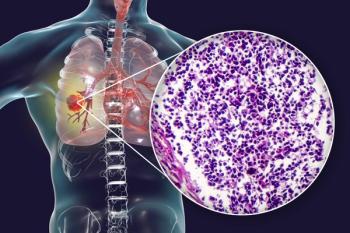
Data from a phase 3b trial support a supplemental new drug application in China for savolitinib in previously treated non–small cell lung cancer with MET exon 14 alterations.

MK-1084 previously demonstrated manageable safety and preliminary activity in non–small cell lung cancer harboring KRAS G12C mutations as part of a phase 1 trial.

Treatment with adagrasib in the phase 3 KRYSTAL-12 trial raised no new safety signals among patients with KRAS G12C–mutated non–small cell lung cancer.

Data from the phase 3 KEYNOTE-671 trial support the European Commission’s approval of pembrolizumab plus chemotherapy for those with resectable non–small cell lung cancer.

Intracranial disease control with Ivonescimab plus chemotherapy appears encouraging in patients with non–small cell lung cancer and brain metastases.

A 50% objective response rate was observed when becotarug plus osimertinnib was combined to treat patients with EGFR exon 12 non–small cell lung cancer.

Treatment with osimertinib plus chemotherapy also shows a consistent survival benefit across prespecified NSCLC subgroups in the phase 3 FLAURA2 trial.

The phase 3 KEYLYNK-006 trial did not meet the primary end points of progression-free and overall survival in patients with metastatic nonsquamous non–small cell lung cancer.
The regulatory agency set an action date of December 28, 2024 for ensartinib as a treatment for those with ALK-positive non–small cell lung cancer.
A cohort study for patients with non–small cell lung cancer found an overall survival benefit when targeted therapies were utilized.
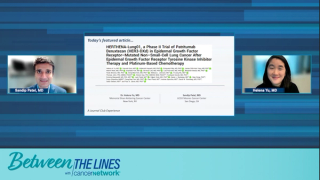
Helena A. Yu, MD, and Sandip P. Patel, MD, reviewed the use of patritumab deruxtecan, which was assessed in the phase 2 HERTHENA-Lung01 trial.

Developers also announced that they completed enrollment of patients with non–small cell lung cancer in the phase 2 THIO-101 trial.
Data from the TROPION-Lung01 and TROPION-Breast01 trials support the EU marketing authorization applications for datopotamab deruxtecan in non–small cell lung cancer and breast cancer, respectively.

The regulatory agency has cleared developers to continue patient enrollment in the phase 2 IOV-LUN-202 trial evaluating LN-145 in non–small cell lung cancer.

Data from the phase 3 PAPILLON trial support the FDA approval of amivantamab plus chemotherapy for patients with metastatic non–small cell lung cancer harboring EGFR exon 20 insertion mutations.
The nivolumab with chemotherapy regimen missed the primary end point on the phase 3 trial of patients with EGFR-mutated non–small cell lung cancer.

Data from the phase 1 portion of the ARROS-1 trial support the breakthrough therapy designation for NVL-520 as a treatment for those with ROS1-positive non–small cell lung cancer.

Dr. Gregory Gan introduces Case 2, involving a 70-year-old former smoker with Stage IIIB NSCLC and a PD-L1 level of 10%, prompting discussion with emphasis on the importance of shared decision-making with the patient and their caregivers.

Findings from 3 phase 3 trials support the marketing authorization application for tislelizumab as a treatment for patients with non–small cell lung cancer in the European Union.

Preliminary findings from a phase 1 trial support the breakthrough therapy designation for BAY 2927088 as a treatment for those with unresectable or metastatic non–small cell lung cancer harboring HER2 mutations.
The European Medicine Agency’s Committee for Medicinal Products for Human Use’s recommendation of approving pembrolizumab plus chemotherapy in resectable non–small cell lung cancer is based on results from the KEYNOTE-671 trial.
Advertisement
Advertisement
Trending on CancerNetwork
1
Modifiable Risk Factors Suggest Potential for Improving Cancer Prevention
2
Barriers to CAR T-Cell Referral and Center Access in Multiple Myeloma
3
2026 Tandem Meetings: What’s the Latest Research in Multiple Myeloma?
4
Real World Outcomes of CAR T-Cell Therapy in Multiple Myeloma Including Older and Comorbid Patients
5