



Colorectal Cancer
Latest News

Advertisement
Latest Videos







CME Content
































Advertisement
More News
mXELIRI could be practice-changing by providing an alternative to irinotecan-based regimens for some patients, but may not work in non-Asian populations.
A large prospective analysis of data from the UK Women’s Cohort Study found an association between red meat consumption and distal colon disease risk.
CR was 36% in the total neoadjuvant therapy cohort vs 21% in the cohort that received chemoradiotherapy with adjuvant chemotherapy.
A team of Finnish researchers has created a deep learning algorithm that appears to help clinicians better predict patient outcomes based on colorectal cancer tissue samples.
In this UK observational study, being obese was linked with an increased risk for colorectal cancer but undergoing prior obesity surgery was not.
A preplanned analysis of ctDNA found that a subpopulation of mCRC patients with acquired anti-EGFR resistance were sensitive to treatment with Sym004.
Patients with familial adenomatous polyposis have an increased risk for colorectal polyps and cancer; however, treatment with a combination of sulindac and erlotinib reduced their colorectal polyp burden by more than two thirds.
The STAT3 inhibitor napabucasin significantly improved survival among patients with colorectal cancer with elevated phosphorylated STAT3 expression.
Investigators found a methylation-independent loss of MYO5B expression in CRC that matched disease progression, which indicates that the use of MYO5B alone or in combination with its adapter protein RAB8A is a prognostic marker for the disease.
Adding bevacizumab maintenance therapy failed to improve outcomes compared with no treatment when administered during chemotherapy-free intervals to patients with metastatic colorectal cancer after induction chemotherapy.
Patients with DNA mismatch repair-deficient/microsatellite instability-high metastatic colorectal cancer who received nivolumab along with ipilimumab had high response rates and improved survival outcomes compared with those who received nivolumab alone.
A diet rich in foods known to cause inflammation may increase the risk for colorectal cancer by about one-third, according to the results of a newly published study.
A test measuring circulating tumor cells in the bloodstream was able to accurately detect early-stage colorectal cancers, according to the results of a new study.
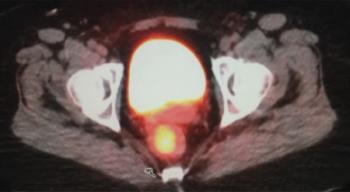
A 56-year-old Caucasian woman presented to her primary care physician with a 3-month history of intermittent bright red rectal blood with defecation. At her initial visit, a digital rectal examination, anoscopy, and a pelvic examination with DNA testing for high-risk HPV were performed; all results were negative. She was referred for a colonoscopy, which revealed an abnormal area with a 3 × 4–cm mass in the rectum at a distance of 10 cm from the anal verge.
Patients with metastatic colorectal cancer and high expression of VEGF-D garner more benefit from the VEGFR-2 antibody ramucirumab than those with low VEGF-D expression, according to a new study.
A large meta-analysis found that current and former smoking status was associated with poorer colorectal cancer prognosis compared with never smoking, and that smoking cessation may improve survival over those who continue to smoke.
A previously healthy 36-year-old man initially presented to his primary care physician with occasional bloody stools and dull right upper quadrant pain. Blood was sometimes mixed into his stools but was more often seen on the toilet paper after wiping.

In this interview, we discuss an assay that can detect disease recurrence in colorectal cancer patients.
Adherence to treatment guidelines for stage II or III colon cancer improved from 2001 to 2011 and resulted in improved survival outcomes.
Utilization of testing for mismatch repair deficiency was poor and underused in a large population of patients with colorectal cancer.
Aprepitant plus palonosetron and dexamethasone showed early promise for preventing chemotherapy-induced nausea and vomiting among patients with colorectal cancer who are undergoing FOLFOX chemotherapy, according to results of a small pilot study.
Anti-EGFR therapy is a valuable addition to the armamentarium of treatment options for patients with metastatic colorectal cancer. However, RAS mutation status is an imperfect biomarker for prediction of therapeutic outcomes in this setting. The recent discovery of tumor sidedness as a predictor of response highlights how little we understand about which patients are the most appropriate to receive drugs that target EGFR.
HER3 messenger RNA expression may serve as a biomarker for patients with RAS wild type colorectal cancer who will benefit from treatment with the anti-EGFR therapy panitumumab, according to the results of a new study.
A combination of oral antibiotics and mechanical bowel preparation helped to decrease the rate of surgical site infections in patients undergoing rectal cancer resections.
In this article, we provide a summary of nonoperative management of locally advanced rectal cancer in the modern era. Our focus is on technical details of tumor response and patient assessment after chemoradiotherapy, as well as a review of existing clinical data.
Advertisement
Advertisement
Trending on CancerNetwork
1
Modifiable Risk Factors Suggest Potential for Improving Cancer Prevention
2
2026 Tandem Meetings: What’s the Latest Research in Multiple Myeloma?
3
Dato-DXd Receives Priority Review in Unresectable/Metastatic TNBC
4
Barriers to CAR T-Cell Referral and Center Access in Multiple Myeloma
5