





Multiple Myeloma
Latest News
Advertisement
Latest Videos


CME Content































Advertisement
More News

Panelists discuss how challenges in the CAR T referral process include delayed referrals, patient logistics, and managing expectations. One institution addresses these through streamlined communication, patient education, and clear referral guidelines. Community physicians should refer early on, ensure candidacy, and collaborate closely to optimize outcomes.
Panelists discuss how, a collaborative approach to co-managing and co-monitoring patients receiving CAR-TCAR T-cell therapy patients, ensuring continuity of care as they transition to community settings. We They employ detailed care plans, electronic health records integration, and regular follow-ups with community providers to facilitate seamless transitions.
Panelists discuss how CAR T-cell therapy involves engineering a patient’s T cells to target cancer cells. The process includes cell collection, genetic modification, expansion, and reinfusion and streamlines the process with integrated workflows. Bridging therapy is provided in-house to treat patients awaiting CAR-T infusion.

Additionally, the Chinese Society of Clinical Oncology and Chinese Anti-Cancer Association guidelines recommend the isatuximab regimen for this population.

Subcutaneous isatuximab yields noninferior results vs intravenous isatuximab when paired with pomalidomide and dexamethasone in the phase 3 IRAKLIA trial.
Anito-cel produced no delayed or non–immune effector cell–associated neurotoxicity syndrome among patients with multiple myeloma.
During the 2024 IMS Annual Meeting, colleagues gathered to discuss the latest advancements in multiple myeloma.
During the 2024 IMS conference, teams from Cleveland, Ohio, and New York, New York, met to debate the latest advances in multiple myeloma.

Arlo-cel yields responses among patient subgroups, including those with triple class–refractory disease and extramedullary disease.
Experts in multiple myeloma spoke about optimal treatment strategies for patients who receive bispecific therapy, focusing specifically on facilitating a multifaceted approach between academic and community practices.

An isatuximab-based quadruplet yields significant long-term benefits regardless of subsequent maintenance in in patients with transplant-eligible NDMM.
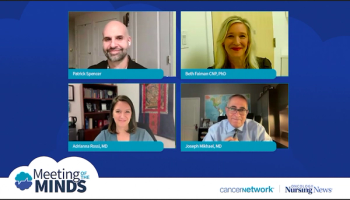
This segment explores factors influencing patient candidacy for CAR-T therapy, including age, fitness, and relapse specifics, and evaluates key findings from the KarMMa trials to compare ide-cel with other second-line treatment options for multiple myeloma.
This segment explores the treatment journey of a 55-year-old mother and high school teacher with ALK-positive NSCLC and brain metastases, focusing on her experience with lorlatinib therapy.

Panelists discuss how the treatment paradigm for newly diagnosed multiple myeloma (NDMM) has evolved from conventional chemotherapy to modern regimens incorporating novel agents like proteasome inhibitors, immunomodulatory drugs, and monoclonal antibodies while highlighting persistent challenges including optimizing treatment sequencing and addressing high-risk disease.

The Post–CAR T Journey: Long-Term Monitoring, Multidisciplinary Care, and Continuous Patient Support
Panelists discuss how health care centers provide comprehensive long-term monitoring and support services for both patients receiving CAR T and their caregivers in the posttreatment period, including regular medical assessments and ongoing educational resources.
Panelists discuss how patients and medical teams navigate the complex CAR T therapy journey, from initial referral through cell collection, manufacturing, and infusion, while highlighting crucial monitoring strategies for managing adverse effects such as cytokine release syndrome and neurotoxicity.

Real-world data show that CAR T-cell therapy may be considered for eligible patients with relapsed/refractory multiple myeloma harboring CNS involvement.
Panelists discuss how a patient and their medical team collaborated to evaluate the differences between ide-cel and cilta-cel CAR T therapies to make an informed treatment decision.
Panelists discuss how clinical trial data from CARTITUDE-1, CARTITUDE-4, and KarMMa-3 demonstrate the efficacy of CAR T therapies cilta-cel and ide-cel in multiple myeloma, comparing their real-world outcomes and considering patient-specific factors for treatment selection.

Lisaftoclax with pomalidomide and dexamethasone elicited positive efficacy and safety outcomes in relapsed/refractory multiple myeloma.
In patients with lens-refractory multiple myeloma, cilta-cel generated deeper minimal residual disease rates across all patient subgroups.

Pelabresib and ruxolitinib combination maintains consistent reduction of symptoms and anemia in patients with myelofibrosis.

Patients with newly diagnosed multiple myeloma experienced sustained MRD negativity with isatuximab/bortezomib/lenalidomide/dexamethasone.
Findings from DREAMM-7 support belantamab mafodotin plus bortezomib and dexamethasone as a standard of care in relapsed/refractory multiple myeloma.
Samatha Shenoy, NP, MSN, highlighted lifestyle recommendations to help patients who are receiving talquetamab treatment for multiple myeloma.
Advertisement
Advertisement
Trending on CancerNetwork
1
Modifiable Risk Factors Suggest Potential for Improving Cancer Prevention
2
2026 Tandem Meetings: What’s the Latest Research in Multiple Myeloma?
3
Dato-DXd Receives Priority Review in Unresectable/Metastatic TNBC
4
Barriers to CAR T-Cell Referral and Center Access in Multiple Myeloma
5